|
<< Click to Display Table of Contents >> Fault Level Calculations (IEC 60909) Source Impedance Hand Calculations Transformer Modelling NECR |
  
|
|
<< Click to Display Table of Contents >> Fault Level Calculations (IEC 60909) Source Impedance Hand Calculations Transformer Modelling NECR |
|
See Also:
Hand Calculations for Fault Currents
To perform a fault level calculation, a busbar must be flagged as faulted.
This is done by right-clicking the busbar with the mouse and selecting the Fault Command from the Pop-up Menu. This removes faults placed on any other bus bar. In order to place faults on multiple bus bars, the user must hold down the Shift key, right click on the bus bar and select to place a fault.
After the Bus Bar is flagged, Press the Fault Button  on the Toolbar OR Select Calculate, Fault from the main menu. This will calculate the fault flow at each individual busbar for the entire network.
Pressing the Fault Flow Button  on the Toolbar OR Select Calculate, Fault Flow from the main menu, after the bus has been flagged, will calculate the fault flow due to the faulted Bus Bar(s) throughout the network. This is a much shorter and much quicker calculation, giving the user a quick look at the impact of a fault at the selected busbar.
All protection devices that operate as a result of the fault placed in the network will be flagged by the protection symbol's colour being Hashed.
To determine the flow of the fault current, Right-Click on the element and select Results->Fault Flow Tab-sheet.
PowaMaster uses the following technique to calculate the Fault Levels:
Term |
Description |
Zpos |
Positive Sequence Impedance |
Zneg |
Negative Sequence Impedance |
Zzero |
Zero Sequence Impedance |
Zcontact |
Fault Contact Impedance |
Zground |
Ground Impedance |
Ipos |
Positive Sequence Fault Current |
Ineg |
Negative Sequence Fault Current |
Izero |
Zero Sequence Fault Current |
Iabc |
Line Fault Currents |
Fault Current |
Sequence Currents |
Three Phase Fault |
|
Phase to Phase Fault |
|
Phase to Ground Fault |
|
Double Phase to Ground Fault |
|
, |
Line Currents :
To calculate the Source Impedance we need to know at least the following:
1.Three Phase Fault Level, Magnitude and Angle,
2.Single Phase Fault Level, Magnitude and Angle,
3.PU Voltage at the point of interest, Magnitude and Angle.
We first Calculate the Current & Impedance Base Values, where:
Sb = Power Base and
Vb = Voltage Base:
We then use the following formulae to Calculate the per unit Sequence Impedances after we've converted the Fault Currents to per unit values:
Example:
Vb = 132kV
Vs = 1pu, 0°
Sb = 100MVA
I3Ph = 15kA, -80°
I1Ph = 10kA, -80°
Using the above formulae we arrive at the following answers:
Zpos = 0.8823 + j5.0035 Ω
Zneg = 0.8823 + j5.0035 Ω
Zzero = 2.2056 + j12.5087 Ω
Hand Calculations for Fault Currents
Calculate the Three Phase and Phase to Ground Fault on the 11kV busbar (Secondary Transformer Terminal) for the following system:
Device |
Given |
Source |
Voltage = 132kV I3ph = 15 kA<-80° I1f = 10 kA<-80°
|
Overhead Line |
10km Wolf
|
Transformer |
Rating = 10MVA Voltage = 132/11kV Z% = 11.25% X/R = 23 Zzero% = 9.56% X0/R0 = 23 Rneutral = 10Ohms Vector: Ydn11
|
Solution:
Base Values |
Sbase = 100MVA V132base = 132kV Vbase = 11kV
|
Source Impedance |
|
Wolf Overhead Line Impedance Calculations |
|
Transformer |
|
Three Phase Fault Calculation |
Note the dominance of the transformer impedance.
and consider 30 degree phase shift
|
Phase – Ground Fault Calculation |
Note: The transformer - and primary connection zero sequences are blocked in a Ydn Winding and only the Neutral Earthing Resistance (NEC/R) need to be considered.
and consider 30 degree phase shift
|
Compare these results with the PowaMaster results.
•Open the Fault Calc Demo.pmd file.
•Note the use of the Options->Calculations – Use Sending Voltage.
•This forces the assumption of Vsource = 1 p.u.
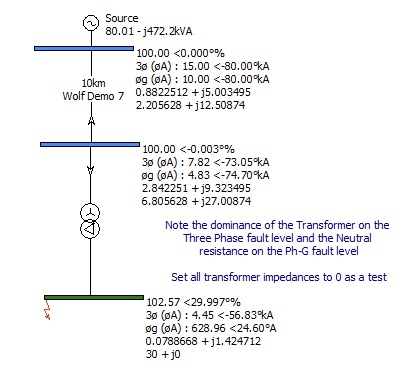
PowaMaster Demo 7