|
<< Click to Display Table of Contents >> Motor Details |
  
|
|
<< Click to Display Table of Contents >> Motor Details |
|

See Also: Motor Modelling
The motor data provides a simple model for performing motor starting. This model is utilised if motor impedance details are not available. The motor model applies a starting curve of Power (p.u.) and Power Factor for various times during start-up. These values can either be measured or can be approximated from known motor start-up parameters (i.e. start-up current and time). The Power is in p.u. to allow the same curve to be applied to various kW rating.
The simple motor model is ultimately a means for users to rapidly model a motor start-up using approximate values for p.u. Power and Power Factor. For LV motors it is more difficult to obtain the equivalent circuit parameters required for an induction motor model. What is attainable from motor catalogues is the motor start-up current. The main purpose for performing motor start-up calculations is to determine the magnitude and duration of the voltage dip created by the motor start-up and to determine the required start-up current handling capability of the conductors. If the start-up Power and Power Factor is unknown, then the user can approximate these values to obtain a start-up current in the PowaMaster model equivalent to that specified for the motor.
Example: 6.6kV, 600kW motor with a start-up current of 250 A.
Assume a start-up p.u. power of 1, Thus the required P.F. is :
Thus the start-up p.u. power and p.f. curve can be approximated for the duration of the start-up.
The Induction motor is modelled on the motor’s equivalent circuit. The following minimum parameters are required for this model:
Field |
Field Description |
Description |
Motor Description |
Vref |
Motor Phase to Phase Voltage |
J |
Moment of Inertia (kg.m^2) |
Poles |
Number of Poles |
Frequency |
Motor Supply Frequency |
Stator R |
Stator Resistance |
Stator X |
Stator Leakage Reactance |
Rotor R |
Rotor Resistance referred to the Stator |
Rotor X |
Rotor Leakage Reactance referred to the Stator |
Mag. R |
Magnetising Resistance |
Mag. X |
Magnetising Resistance |
Load Torque Curve |
Load Torque p.u. curve of the Maximum Motor Torque:
|
For MV motors, these parameters should be available from the motor manufacturers.
This Help File covers the basics of Induction Motor theory.
The induction motor can be modelled using the equivalent circuit shown overleaf. The Rotor resistance transferred to the stator is a function of the speed of the rotor.
The three phase windings of the stator creates a rotating magnetic air gap field that cuts the rotor generating current in the motor and a corresponding back e.m.f. The behaviour of the machine is ultimately related to the synchronous speed and to the slip.
The synchronous speed in a machine is calculated by:
, where P is the pole-pairs.
If the angular speed of the rotor is ωr then the p.u. slip is
Thus at standstill the slip is 1 and moves close to 0 for no-load operation.
The rotor winding is isolated and its power is transferred by means of the mutual gap flux. The slip determines the amount of power transferred. Hence the rotor can never rotate at synchronous speed as the slip would be zero and the air gap flux field would not “cut” the rotor. Hence no current would be induced in the rotor and no rotor torque would be developed.
Exercise: Calculate the synchronous speed in r.p.m. for a 6-pole motor.
The parameters for the equivalent circuit can be obtained from motor manufacturers. Parameters that cannot be obtained can be determined by performing tests on the motors.
No-Load Test:The slip is very small and hence the r2’/s becomes high, making the rotor an open circuit. This allows for the calculation of the Magnetizing impedances.
Short Circuit Test: The rotor is locked and the voltage increased until full load current flows. The Rotor impedances can then be calculated.
The details of the test calculations are not detailed in this Help File.
Ideal Circuit:
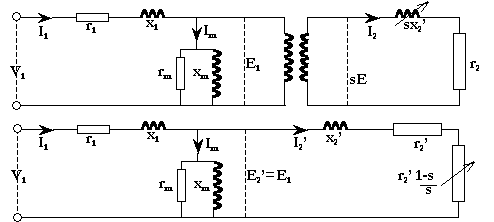
PowaMaster utilises the equivalent circuit parameters to calculate the motor’s power rating, maximum torque, starting current and power factor. The calculations assume unity input voltage to the motor. Once the motor is part of the model then the calculated motor terminal voltage is used to re-calculated the motor's torque curves etc.
From varying the motor parameters one can notice that the motor starting torque is dependant on the rotor resistance. Increasing the rotor resistance increases the motor’s starting torque. This however, increases the slip at which the maximum torque occurs and hence increases the motors running slip. The rotor resistance does not affect the motor’s maximum torque. This has caused motor designers to facilitate means of increasing the rotor resistance at start-up and decreasing this rotor resistance once the motor reaches rated speed.
The Moment of Inertia in the motor model is determined from both the motor rotor and the load connected to the motor. In general this data is supplied for both the motor and the load. If this data is not supplied then equations not covered in this User Guide can be used to calculate the moment of inertia e.g: the moment of inertia for a cylinder is where M is Mass kg and r is radius in metres.
The motor load is modelled with a user-defined equation as a function of slip -f(slip). This allows the user to model the load torque variation with speed. This per unit curve is based on the Maximum Motor Torque.
The Load Torque is typically: |
|
Constant Torque (e.g. conveyer belts, piston compressors) |
e.g. function = 0.1 |
Torque Proportional to Speed (screw compressors) |
e.g. function = 0.1 * Slip + 0.01 |
Torque Proportional to Speed2 (pumps, fans) |
e.g. function = 0.1 * Slip2 + 0.01 |
Note: The p.u. torque curve is clipped between 0 and 1.
PowaMaster provides the following Starting Methods:
•DOL (Direct On-Line)
•VSD (Variable Speed Drive)
•Slip Ring
•Stator Impedance
•Auto Transformer
•Star/Delta
Note : The calculation will drop the starter out automatically should the nett acceleration torque approach zero before the running slip is reached.
The direct on-line method calculates the Torque, Power and Current values for a given system input voltage and a specified slip.
The VSD method uses the specified current limit to determine the Frequency Adjustment required to limit the current as specified throughout the slip range (From Starting to Running Slip). PowaMaster assumes a linear relation between Frequency and Voltage and adjusts the input Voltage to the motor with the same ratio. The Torque, Power and Current values are then calculated for this new frequency, voltage and specified slip.
The Slip Ring uses a user defined formula in Ohm to adjust the rotor impedance throughout the starting slip range. This user-defined formula is a function of Slip (s) and Running Slip (rs). e.g. The following function will enable a discreet 3 step switching out of rotor resistors : Ceil( (s - rs) / (1 - rs) * 3 ) / 3. Should a smooth curve be required, it can be entered as follows : 2 * (s - rs) / (1 - rs).
This method calculates the Torque, Power and Current values for a given system input voltage and a specified slip using the calculated rotor impedance for each slip.
All three these methodologies use a reduced system voltage input to the motor to calculate the Torque, Power and Current values for a specified slip. The Stator Impedance and Auto Transformer ratios can be specified by the user. The Star/Delta methodology uses a fixed ratio of 0.577.